
VFD vs Soft Starter: Choosing the Right Motor Control Solution
When your motor application requires more than a simple direct-on-line (DOL) starter, two technologies dominate the industry: Variable Frequency Drives (VFDs) and Soft Starters. While both reduce starting current and mechanical stress, they solve fundamentally different engineering problems. Choosing the wrong one can lead to overspending on unnecessary features or missing critical performance requirements.
This guide breaks down the engineering differences to help you make the right choice for your facility — whether you are specifying panels for a new wastewater treatment plant, upgrading pumping station motor starters, or designing an MCC for a factory expansion.
The Fundamental Difference: Voltage vs. Frequency
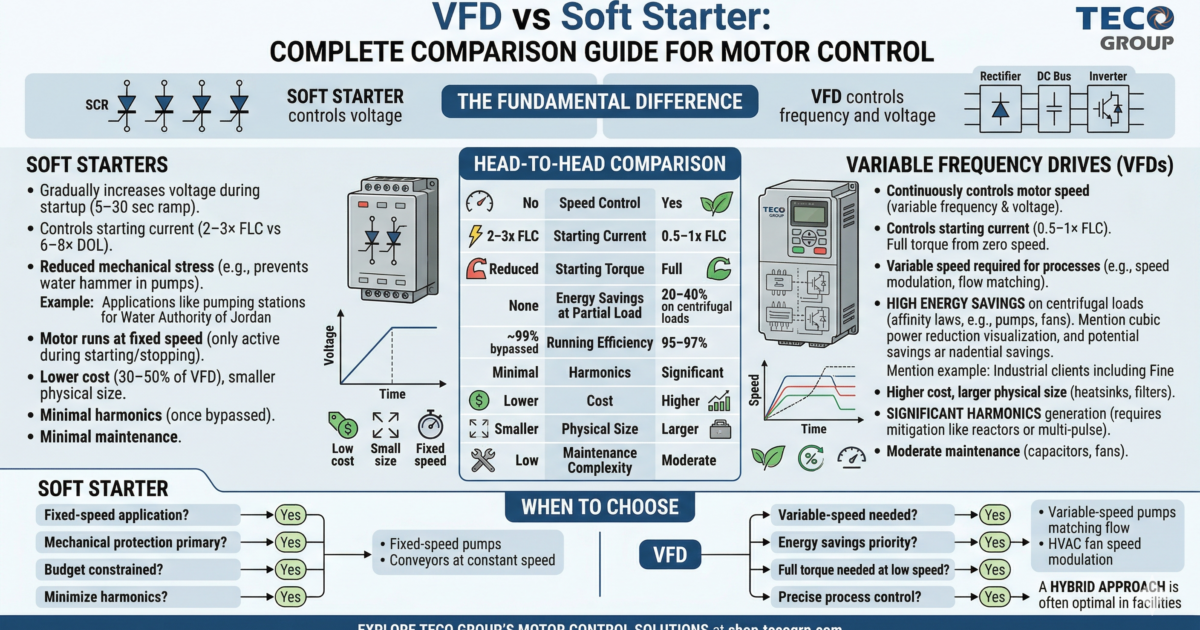
A soft starter controls voltage. A VFD controls both frequency and voltage.
This single distinction drives every difference in performance, cost, and application suitability between the two technologies.
Soft Starters
A soft starter uses thyristors (silicon-controlled rectifiers) to gradually increase the voltage applied to the motor during startup. This ramps the motor from zero to full speed over a controlled period (typically 5–30 seconds), reducing the starting current from the typical 6–8× full-load current (FLC) of DOL starting to approximately 2–3× FLC.
Once the motor reaches full speed, the soft starter typically bypasses its thyristors and connects the motor directly to the mains supply. The motor then runs at a fixed speed. The soft starter only participates during the starting and stopping phases. Learn more about our soft starter panels (ST).
Variable Frequency Drives (VFDs)
A VFD converts the incoming AC supply to DC (rectifier stage), then reconstructs a new AC output at whatever frequency and voltage the application requires (inverter stage). By controlling the output frequency, the VFD provides absolute control over motor speed — from zero to well above rated speed.
The VFD remains active at all times, continuously controlling motor speed throughout operation. It is not just a starting device; it is a comprehensive speed control system. Learn more about our variable frequency drive panels (VFD).
Head-to-Head Comparison: VFD vs Soft Starter
| Parameter | Soft Starter | VFD |
|---|---|---|
| Speed control | No — fixed speed only | Yes — full variable speed |
| Starting current | 2–3× FLC | 0.5–1× FLC |
| Starting torque | Reduced (proportional to V²) | Full torque available from zero speed |
| Energy savings at partial load | None — motor runs at full speed | 20–40% on centrifugal loads (pumps, fans) |
| Running efficiency | ~99% (bypassed thyristors) | 95–97% (conversion losses) |
| Harmonics generated | Minimal (only during start) | Significant — requires harmonic mitigation |
| Motor cable length | Unlimited | Limited (typically 50–100m without filter) |
| Cost (per kW) | Lower (30–50% of VFD cost) | Higher |
| Physical size | Smaller | Larger (heatsinks, filters, DC bus) |
| Maintenance complexity | Low | Moderate (capacitors, fans, firmware) |
When to Choose a Soft Starter
Soft starters are the optimal choice when:
1. The Application Runs at Fixed Speed
If the motor always operates at its rated speed, a soft starter is the most cost-effective solution. Examples include fixed-speed pumps in water distribution, compressors with mechanical unloading, and conveyor systems running at constant speed.
2. Mechanical Protection is the Primary Goal
Soft starting reduces mechanical shock, extending the life of belt drives, gearboxes, and bearings. TECO GROUP has supplied soft starter panels for the Water Authority of Jordan and projects like the Wadi Shallala Irbid WWTP, where preventing water hammer in pumping stations is critical for infrastructure longevity.
3. Budget and Harmonics are Constraints
Soft starters are significantly cheaper than VFDs and generate almost no harmonics once the motor is up to speed. This makes them ideal for facilities with strict power quality requirements or limited budgets. When paired with an automatic power factor correction (APFC) panel, the combination delivers reliable motor starting with optimised power quality at a fraction of VFD cost.
When to Choose a VFD
VFDs are the right choice when:
1. Variable Speed and Process Control are Required
Any process requiring speed modulation demands a VFD. This includes HVAC fans, variable-flow pumps, and crane hoists requiring precise positioning. TECO GROUP integrates VFD panels with PLC control systems for automated speed setpoint management based on process variables like pressure, flow, and level.
2. Energy Savings are a Priority
On centrifugal loads (pumps and fans), energy savings follow the Affinity Laws: power is proportional to the cube of the speed. Reducing a pump’s speed by just 20% can cut power consumption by nearly 50%. TECO GROUP has delivered VFD panels for industrial projects like Arab Potash Company (APC) Plant Optimisation, where energy optimisation across the solar pond booster pumps is a primary operational driver.
3. High Starting Torque is Needed
Applications like loaded conveyors, crushers, or mixers require high breakaway torque at low speeds. Only a VFD can maintain rated torque from zero speed upward. For applications where reduced voltage starting is sufficient but DOL is too aggressive, autotransformer starters (ATST) offer another alternative with higher starting torque than soft starters.
The Hybrid Approach and Harmonics
Many industrial facilities use a strategic mix: VFDs for duty and variable-speed motors to capture energy savings, and soft starters for standby or fixed-speed auxiliary motors. TECO GROUP designs custom motor control center (MCC) panels that integrate both technologies in a single coordinated lineup — with all motor starting types sharing a common MDB busbar and protection coordination scheme.
When implementing VFDs, we also specify appropriate harmonic mitigation — such as input line reactors or DC bus chokes — to prevent interference with sensitive equipment and overheating of transformers. For facilities with high harmonic content, our APFC panels with detuned harmonic filters provide additional power quality protection.
Partner With TECO GROUP for Motor Control
Whether you need a single soft starter panel, a VFD panel, or a complete MCC system integrating both, TECO GROUP brings engineering rigor to every project. All panels are assembled in our ISO 9001 certified production facility in Amman and 100% factory tested before dispatch.
View our complete reference list of delivered motor control projects, or contact our engineering team for a consultation →