
Power Factor Correction: How APFC Panels Eliminate Utility Penalties and Reduce Your Electricity Bill
If your factory’s electricity bill includes a power factor penalty line item — or if you have never checked — you are likely paying more than you should. Poor power factor is one of the most common and most fixable sources of wasted money in industrial electrical systems.
This article explains what power factor is, why it matters, and how Automatic Power Factor Correction (APFC) panels eliminate the problem.
What Is Power Factor?
Power factor (PF) is the ratio of real power (kW) — the power that does useful work — to apparent power (kVA) — the total power drawn from the grid. It is expressed as a number between 0 and 1, or as a percentage.
PF = kW / kVA
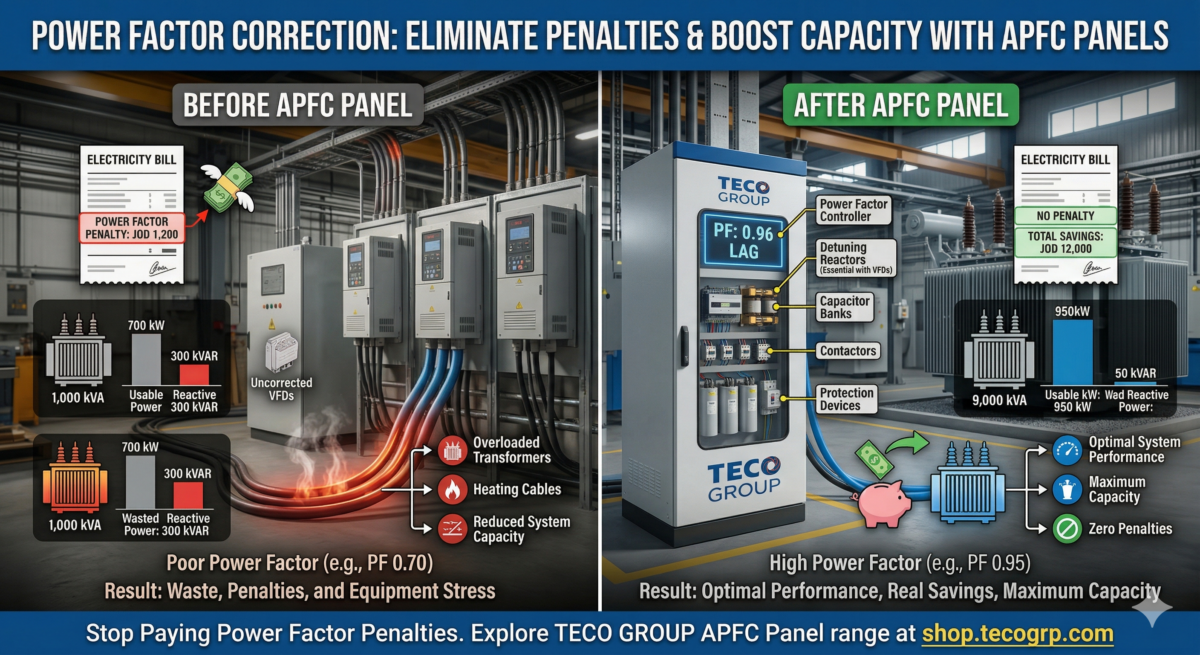
A power factor of 1.0 (unity) means all the power drawn from the grid is being used productively. A power factor of 0.7 means only 70% of the drawn power does useful work — the remaining 30% circulates as reactive power, heating cables, overloading transformers, and increasing losses without contributing to production.
Why Does Power Factor Drop?
Inductive loads are the primary cause of poor power factor in industrial facilities:
- Electric motors — especially lightly loaded motors running well below their rated capacity. This is common in motor control center (MCC) installations where motors cycle between full load and standby.
- Transformers — particularly when operating at partial load, common in facilities where MDB capacity was sized for future expansion.
- Fluorescent and HID lighting with magnetic ballasts.
- Welding machines and induction furnaces.
- Uncompensated VFDs and power converters — a growing concern as more facilities adopt variable speed drives for energy savings.
A typical industrial facility with many motors and no power factor correction operates at a PF of 0.65–0.80 — well below the 0.90–0.95 threshold that most utilities require.
The Real Cost of Poor Power Factor
1. Utility Penalties
Electricity providers in Jordan (JEPCO, IDECO, EDCO) and across the MENA region impose penalties when power factor falls below a defined threshold (typically 0.85 or 0.90). These penalties can add 5–15% to your monthly electricity bill — a direct, recurring cost that compounds year after year.
2. Increased Cable and Equipment Losses
Low power factor means higher current for the same real power output. Higher current means greater I²R losses in cables (more heat, more wasted energy), overloaded transformers that age faster and may need upsizing, and voltage drops that affect sensitive equipment performance. A thermal imaging inspection of your switchgear will often reveal overheating connections caused by excessive reactive current.
3. Reduced System Capacity
A transformer rated at 1,000 kVA with a load power factor of 0.70 can only deliver 700 kW of useful power. Correct the power factor to 0.95 and the same transformer delivers 950 kW — a 36% increase in usable capacity without any hardware upgrade.
4. Voltage Instability
High reactive current causes voltage fluctuations that affect motor performance, lighting quality, and electronic equipment reliability — including sensitive PLC control systems and SCADA installations.
How APFC Panels Work
An Automatic Power Factor Correction panel contains banks of capacitors and a microprocessor-based controller that continuously monitors the power factor at the point of installation. When the controller detects that power factor has dropped below the target (typically 0.95 or higher), it automatically switches in capacitor steps to inject reactive power and bring the power factor back to the target.
As loads change throughout the day — motors starting and stopping, production lines ramping up and down — the APFC controller dynamically adds or removes capacitor banks to maintain optimal correction. This real-time response is what distinguishes automatic correction from fixed capacitor banks, which can cause dangerous over-correction during light-load periods.
Key Components of an APFC Panel
- Power factor controller — monitors PF in real time, determines correction steps. TECO GROUP uses advanced ABB, Epcos, and Siemens controllers offering front panel status reporting and communication interfaces.
- Capacitor banks — provide reactive power compensation (rated in kVAr), sized from small commercial installations up to 850 kVAr and beyond for heavy industrial loads.
- Contactors or thyristor switches — switch capacitor steps on/off (thyristor switching for fast-changing loads).
- Detuning reactors — protect capacitors from harmonic currents (essential in facilities with VFDs and other non-linear loads).
- Protection devices — HRC fuses or MCCBs for each capacitor step.
Sizing an APFC Panel
Proper sizing requires measuring your facility’s reactive power demand. Our consultation services team can perform a power factor audit using our testing equipment to determine the exact correction requirement. The basic calculation:
Required kVAr = kW × (tan φ₁ − tan φ₂)
Where kW is your real power demand, φ₁ is the angle corresponding to your current (uncorrected) power factor, and φ₂ is the angle corresponding to your target power factor.
For example, a factory drawing 500 kW at PF 0.75 that wants to reach PF 0.95:
- tan φ₁ (PF 0.75) = 0.882
- tan φ₂ (PF 0.95) = 0.329
- Required kVAr = 500 × (0.882 − 0.329) = 276.5 kVAr
TECO GROUP manufactures APFC panels in a wide range of configurations — from small commercial units to large industrial systems — all designed to IEC 61439 and IEC 60947 standards and 100% factory tested with RFT certification before dispatch.
The Harmonic Factor: Why Detuning Matters
Modern industrial facilities are filled with non-linear loads — VFDs, UPS systems, LED drivers, and computer power supplies — that inject harmonic currents into the electrical system. These harmonics can resonate with capacitor banks, causing capacitor overheating and premature failure, blown fuses and nuisance tripping, and amplified voltage distortion throughout the facility.
Detuned APFC panels include series reactors (typically 7% or 14% detuning factor) that shift the resonant frequency away from common harmonic orders, protecting both the capacitors and the electrical system. If your facility has VFDs or other significant non-linear loads, detuned APFC is not optional — it is essential. TECO GROUP has delivered detuned APFC systems up to 850 kVAr for the Tiper project with advanced ABB controllers handling harmonic-rich industrial loads up to 4000A.
Return on Investment
APFC panels typically pay for themselves within 6–18 months through:
- Elimination of power factor penalties (5–15% of electricity bill).
- Reduced kVA demand charges.
- Lower cable and transformer losses.
- Freed transformer capacity (defer costly upgrades).
For a factory paying JOD 10,000/month in electricity with a 10% power factor penalty, the annual saving is JOD 12,000 — often exceeding the cost of the APFC panel itself.
TECO GROUP APFC Solutions
TECO GROUP designs and builds APFC panels for industrial facilities across Jordan and the region. Our installations include heavy industrial sites like Arab Potash Company (APC), Tiper, and Al-Taj Pharma Plant, as well as international hotels like the DoubleTree by Hilton Aqaba and Sheraton Hotel Amman — where power quality and reliability are critical.
Every APFC panel undergoes routine factory testing including capacitor bank switching verification, power factor response measurement, and harmonic analysis where detuning is applied.
Stop paying power factor penalties. Contact our engineering team for a power factor audit and tailored correction solution →
Or explore our full LV switchgear product range and complete reference list of delivered projects.