
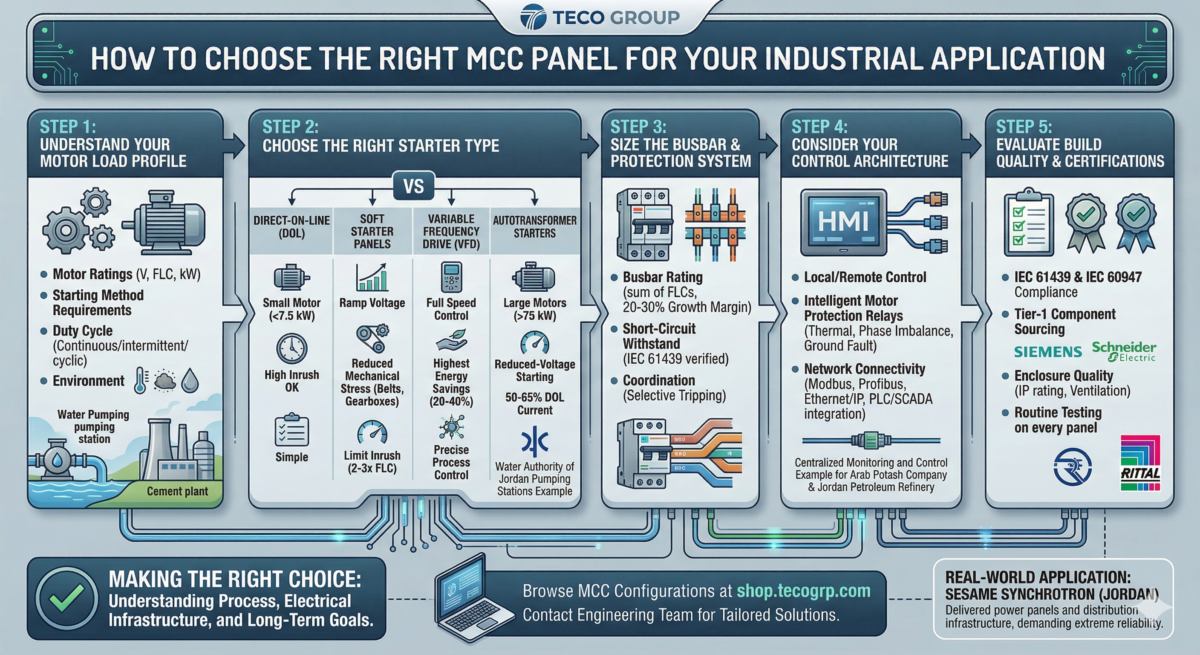
How to Choose the Right MCC Panel for Your Facility
Motor Control Centers are the operational backbone of any industrial facility. Whether you are running pumps at a water treatment plant, conveyors in a mining operation, or HVAC systems in a commercial building, the MCC panel you choose determines how reliably — and how efficiently — your motors perform.
Choosing the wrong MCC configuration leads to unplanned downtime, excessive energy consumption, and maintenance headaches that compound over the life of the installation. This guide walks you through the key decisions so you get it right the first time.
What Is an MCC Panel?
A Motor Control Center is a centralised assembly of motor starters, variable frequency drives (VFDs), protection devices, and control circuits housed in a common enclosure. Unlike scattered individual starters, an MCC consolidates motor control into a single, organised switchgear lineup — simplifying wiring, maintenance, and monitoring.
MCC panels are designed and manufactured to IEC 61439 (low-voltage switchgear assemblies) and IEC 60947 (low-voltage switchgear and controlgear), ensuring safety, thermal performance, and short-circuit withstand capability are independently verified. TECO GROUP builds all MCC panels in our ISO 9001 certified production facility with forms of construction up to Form 4.
Step 1: Understand Your Motor Load Profile
Before selecting an MCC, map out every motor in your facility:
- Motor ratings — voltage, full-load current (FLC), and power (kW).
- Starting method requirements — does the application need soft starting, speed control, or simple direct-on-line (DOL) starting?
- Duty cycle — continuous, intermittent, or cyclic?
- Environment — ambient temperature, dust, humidity, corrosive gases.
A water pumping station with fixed-speed pumps has very different MCC requirements than a cement plant running variable-speed conveyors. Our consultation services team can help you map your load profile correctly — preventing over-engineering (wasted budget) and under-engineering (premature failures).
Step 2: Choose the Right Starter Type
The starter type is the single most impactful decision in MCC design. Here are your main options:
Direct-On-Line (DOL) Starters
Best for small motors (typically below 7.5 kW) where high inrush current is acceptable. Simple, cost-effective, and reliable. DOL starters apply full voltage instantly, so they are unsuitable for applications where mechanical shock or voltage dip is a concern.
Soft Starter Panels
Soft starters ramp voltage gradually during startup, reducing mechanical stress on belts, couplings, and gearboxes. They also limit inrush current to 2–3× FLC instead of the 6–8× typical of DOL starting. Ideal for pumps, compressors, and fans where smooth acceleration matters but variable speed operation is not required. TECO GROUP has supplied soft starter panels for projects including Wadi Shallala Irbid WWTP and Muhammad Ali Al-Qawouk Company (75 KW).
Variable Frequency Drive (VFD) Panels
VFDs provide full speed control by varying the frequency and voltage supplied to the motor. They deliver the highest energy savings — often 20–40% on centrifugal loads like pumps and fans — and enable precise process control. VFD panels are the premium choice but require careful harmonic analysis and proper cable shielding. When VFDs are installed, we recommend pairing them with detuned APFC panels to prevent harmonic resonance with capacitor banks.
Autotransformer Starters
Autotransformer starters (ATST) are used for large motors (typically 75 kW and above) where reduced-voltage starting is needed but VFD cost is not justified. Autotransformer starters reduce starting current to 50–65% of DOL values. TECO GROUP has supplied hundreds of autotransformer starter panels for the Water Authority of Jordan’s pumping stations — a proven solution for high-power fixed-speed applications up to 1000 KW.
Not sure which starter type to choose? Read our detailed comparison: VFD vs Soft Starter — Choosing the Right Motor Control Solution.
Step 3: Size the Busbar and Protection System
The MCC busbar must handle the total connected load plus a margin for future expansion (typically 20–30%). Key sizing considerations:
- Busbar rating — calculate the sum of all motor FLCs, apply diversity factors, and add growth margin. TECO GROUP’s MCC busbars are built on the Ri4Power modular platform for type tested ratings up to 6300A.
- Short-circuit withstand — the MCC must withstand the prospective fault current at the point of installation (verified per IEC 61439). Our testing laboratory performs high voltage testing up to 40 KV to verify withstand capability.
- Coordination — ensure upstream and downstream protective devices are coordinated so that only the faulted circuit trips, not the entire MCC. This is especially important when the MCC is fed from a main distribution board (MDB) with bus couplers providing dual-source redundancy.
Step 4: Consider Your Control Architecture
Modern MCCs do more than start and stop motors. Consider whether you need:
- Local/remote control — selector switches on the MCC door plus remote inputs from a PLC control system or SCADA system.
- Intelligent motor protection relays — providing thermal, overload, phase imbalance, and ground fault protection with communication capability.
- Network connectivity — Modbus, PROFINET, or Industrial Ethernet for integration into plant-wide distributed control systems (DCS).
- Process MIMIC integration — real-time animated motor status displays on operator workstation screens.
TECO GROUP designs MCC panels with integrated PLC and SCADA connectivity as an authorized Siemens system integrator, enabling centralised monitoring and control from a single operator station. This is critical for facilities like Arab Potash Company (APC), where hundreds of motors across the solar pond complex are monitored in real time via wireless microwave communication.
Step 5: Evaluate Build Quality and Certifications
Not all MCC manufacturers are equal. When evaluating a supplier, verify:
- IEC 61439 compliance — demand type-test or design verification reports.
- Component sourcing — are circuit breakers, contactors, and relays from tier-1 international manufacturers with full traceability?
- Enclosure quality — IP rating, paint finish, gland plates, and ventilation design.
- Testing — does the manufacturer perform routine testing (insulation resistance, wiring verification, high voltage, functional testing) on every panel? TECO GROUP issues an RFT certificate with every MCC panel.
- Primary injection testing — is the manufacturer capable of injecting actual current through breaker trip units to verify end-to-end protection?
- Thermal imaging — can post-assembly thermal verification be performed to detect hot spots before dispatch?
Real-World Application: SESAME Synchrotron
When the SESAME synchrotron facility in Allan, Jordan needed electrical distribution and motor control for its storage ring and beamlines, TECO GROUP delivered the power panels and distribution infrastructure. This project demanded extreme reliability, precision EMC performance, and IEC 61439 compliance — the kind of engineering discipline that carries over into every industrial MCC we build. Read the full case study: Powering SESAME Synchrotron.
More Real-World MCC Projects by TECO GROUP
- 2500 MT SRC Cement Steel Silo — MCC Form 4 with DCS for cement industry production control.
- Wadi Arab WWTP — MCC within complete plant switchgear with MV substation and 2× 2000 KVA transformers.
- Shidia Mines WWTP — MCC with ATS, MDB, SMDB, and SCADA for mining sector wastewater treatment.
- Al-Taj Pharma Plant — MCC with MDB, SMDB, APFC, and FDB for pharmaceutical manufacturing.
- Tiper — MCC within MDB 4000A and 3200A installation with APFC harmonic filters at 850 KVAR.
- View our complete reference list of delivered MCC projects.
Making the Right Choice
Selecting an MCC panel is not a catalogue exercise. It requires understanding your process, your electrical infrastructure, and your long-term operational goals. The right MCC reduces energy costs, minimises downtime, and scales with your facility.
Need help specifying an MCC panel for your facility? Contact TECO GROUP’s engineering team for a tailored solution →
We design, manufacture, test, and commission — all under one roof. Explore our MCC product range and full LV switchgear catalogue.