
ATS vs Manual Transfer Switch: Which Does Your Building Need for Generator Backup?
Every building with a backup generator faces a fundamental question: when the mains power fails, how quickly and how safely does the load transfer to the generator — and back again?
The answer depends on whether you install an Automatic Transfer Switch (ATS) or a manual transfer switch. The choice affects everything from occupant safety to equipment protection to regulatory compliance. Here is what you need to know.
How Transfer Switches Work
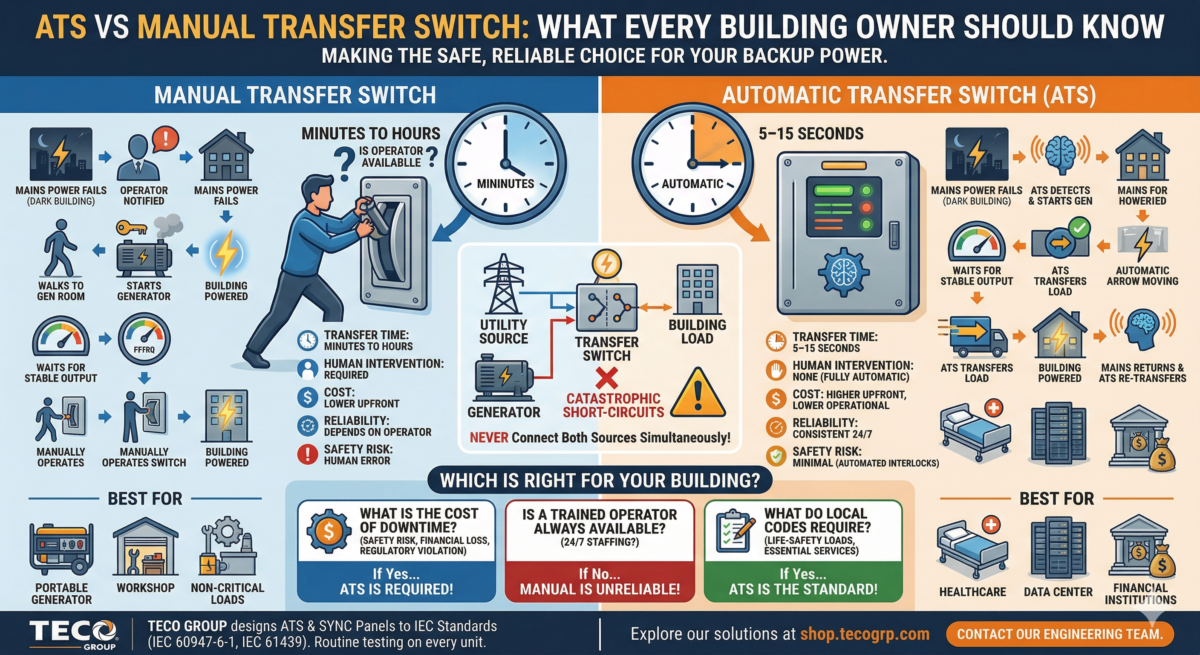
A transfer switch sits between your utility supply, your generator, and your building loads. Its job is simple in concept: connect the load to whichever source is live and healthy, and never — under any circumstance — connect both sources simultaneously. Parallel connection without synchronisation causes catastrophic short-circuit currents that can destroy equipment and endanger lives.
Manual Transfer Switch
A manual transfer switch requires a person to physically operate the switch handle when power fails. The typical sequence: mains power fails and the building goes dark, the operator discovers the outage, walks to the generator room and starts the generator, waits for voltage and frequency to stabilise, then manually operates the transfer switch to move the load. When mains returns, the operator reverses the process.
Transfer time: Minutes to hours, depending on operator availability.
Automatic Transfer Switch (ATS)
An ATS monitors both power sources continuously. When it detects a mains failure, it automatically signals the generator to start, waits for stable output, and transfers the load — all without human intervention. When mains returns and stabilises, the ATS automatically retransfers the load and signals the generator to cool down and stop.
Transfer time: Typically 5–15 seconds for the full sequence (detection + generator start + transfer).
TECO GROUP manufactures three ATS types: motorised changeover with manual bypass, motorised MCCB 4-pole, and motorised ACB 4-pole — with intelligent Woodward EASYGEN controllers for automatic source monitoring and programmable transfer timing. Learn more on our ATS product page.
Key Differences at a Glance
| Factor | Manual Transfer Switch | Automatic Transfer Switch (ATS) |
|---|---|---|
| Transfer time | Minutes to hours | 5–15 seconds |
| Human intervention | Required every time | None (fully automatic) |
| Cost | Lower upfront | Higher upfront, lower operational |
| Reliability | Depends on operator availability | Consistent, 24/7 |
| Safety risk | Operator error, delayed response | Minimal — automated interlocks |
| Maintenance | Simpler mechanism | Requires periodic testing |
| Best for | Small non-critical loads | Hospitals, hotels, banks, any critical facility |
When a Manual Transfer Switch Is Sufficient
Manual switches still have a place in specific scenarios:
- Small residential installations with a portable generator and non-critical loads.
- Workshops or warehouses where a power interruption of 30+ minutes is acceptable.
- Budget-constrained projects where the building use case does not justify automation.
However, manual switches introduce human error risk. An inexperienced operator can attempt to transfer under load without proper generator stabilisation, or worse, accidentally parallel the sources. Mechanical interlocks mitigate this but do not eliminate the risk entirely.
When You Need an ATS
For most commercial, institutional, and industrial buildings, an ATS is not a luxury — it is a requirement:
Hospitals and Healthcare
Patient safety depends on uninterrupted power. Ventilators, monitoring equipment, surgical lighting, and medication refrigeration cannot tolerate minutes-long outages. TECO GROUP has supplied ATS panels for critical healthcare facilities including Istiklal Hospital (motorised changeover ATS 1250A and 400A standalone IN-OUT panels) and Abd El Hadi Hospital — where transfer to generator backup must happen within seconds. View all our hospital projects.
Hotels and Hospitality
Guest experience and safety systems (fire alarms, emergency lighting, lifts) depend on seamless power transfer. TECO GROUP has delivered ATS panels for DoubleTree by Hilton Aqaba, Sheraton Hotel Amman, and Marina Town Hotel Tala Bay. View all our hotel projects.
Banks and Financial Institutions
Transaction processing, vault systems, and security infrastructure must remain powered. TECO GROUP has supplied ATS panels for Jordan Islamic Bank branches and Islamic International Arab Bank — institutions where even a brief outage disrupts operations and compromises security.
Industrial Facilities
Process plants like Arab Potash Company (APC) and manufacturing facilities use ATS systems to protect continuous processes where an uncontrolled shutdown causes product loss, equipment damage, or safety hazards. TECO GROUP has also delivered ATS within complete MCC and MDB installations for Megapipes Weholite Factory with generator synchronising panels.
Wastewater Treatment Plants
Continuous biological treatment processes cannot tolerate power interruption. TECO GROUP has supplied ATS as part of complete switchgear for Wadi Arab WWTP, Airport FreeZone WWTP, and Shidia Mines WWTP. View all our WWTP projects.
Government and Military
Critical government functions and military installations require automatic transfer to maintain operational readiness. TECO GROUP has delivered electrical infrastructure for the Shooting Tunnel Khalidiya and Central Narcotics Division where reliability is non-negotiable. View all our commercial and government projects.
ATS Standards and Compliance
ATS panels must comply with IEC 60947-6-1 (automatic transfer switching equipment) and the broader IEC 61439 assembly standard. Key performance parameters include transfer time (maximum time from source failure detection to completed load transfer), withstand rating (the short-circuit current the ATS can safely handle), mechanical endurance (typically 1,000+ operations minimum), and electrical endurance (operations under load at rated current).
TECO GROUP designs ATS panels to these standards in our production facility and performs routine factory testing on every unit — including transfer sequence verification, timing measurement, interlocking confirmation, and 3 KV high voltage testing — with an RFT certificate issued before dispatch.
Synchronisation Panels: The Advanced Option
For facilities requiring zero-interruption power transfer or parallel generator operation, synchronisation (SYNC) panels go beyond standard ATS functionality. SYNC panels match the voltage, frequency, and phase angle of two sources before closing the tie, enabling seamless load transfer with no break in supply.
TECO GROUP manufactures both standalone ATS panels and integrated ATS/SYNC solutions — custom designed to your generator configuration and critical load requirements. The same bus coupler interlocking principles that govern our dual-source MDB designs are applied to ensure safe, reliable source transfer.
Making the Right Decision
The transfer switch decision should be driven by three questions:
- What is the cost of downtime? If a power interruption causes safety risk, financial loss, or regulatory violation, the ATS pays for itself.
- Is a trained operator always available? If not, manual transfer is unreliable.
- What do local codes require? Many building codes and institutional standards mandate automatic transfer for essential and life-safety loads.
For most commercial and industrial buildings in Jordan and the MENA region, the answer points clearly to an ATS.
Ready to specify a transfer switch solution? Contact our engineering team for project-specific recommendations →
Or explore our ATS product range, full LV switchgear catalogue, and complete reference list of delivered projects.